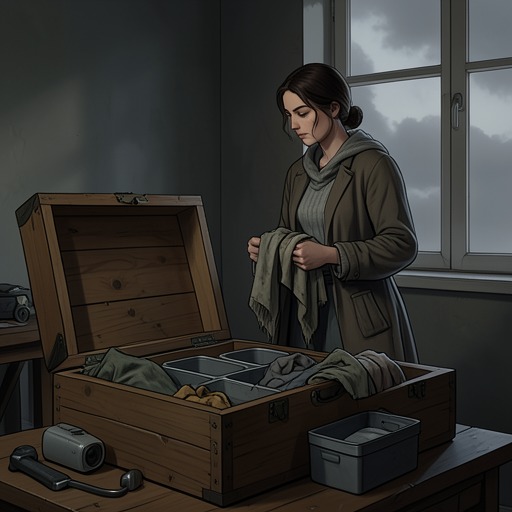
Marcellus’s Captivity-Day Count
Remarkably Bright CreaturesMarcellus’s Captivity-Day Count is the numbered sequence that dates the octopus’s first-person chapters and measures his prolonged life in confinement. In the supplied passages it advances from Day 1,299 to Day 1,349, organizing observations of food, tank routines, human behavior, and concealed objects into a record that changes in tone as Marcellus’s remaining time becomes urgent. At first, the count accompanies the wry precision of a captive observer; near its later entries, it becomes inseparable from his fear that he will die before the people around him understand what he has discovered.
The Count and Its Daily Record
The numbering appears as a recurring chapter marker, beginning here with Day 1,299 of My Captivity. Its form places Marcellus’s account within a specific duration of confinement without supplying a calendar date for that duration. Each advancing number makes the narration feel like a continuing log: the same captive consciousness returns to the same aquarium, while the numbered day registers that another portion of his life has passed. The sequence is not presented as a complete diary in these passages; the visible markers select particular days and leave gaps between them.
Day 1,299 begins with Marcellus waiting each evening for the overhead lights to click off, leaving only the main tank’s glow. Darkness suits him, though the aquarium’s limited lighting is only close enough to the conditions he prefers. The entry makes the count intimate rather than abstract: time is measured through a recurring evening ritual and the artificial light cycle of his enclosure.
The next marker, Day 1,300, turns to food. Marcellus recites the aquarium plaque’s list of crabs, clams, shrimp, scallops, cockles, abalone, fish, and fish eggs, then imagines the open sea as a buffet where such food would be freely available. The list links the captive animal’s practical diet to what confinement denies him: not merely particular meals, but the freedom to hunt and choose. On Day 1,302, the same attention to food becomes comic and bodily. Marcellus reports a weight of sixty pounds and describes an examination that begins with a yellow bucket containing seven scallops. Dr. Santiago prods his mantle with a net, though the scallops would have drawn him into the bucket willingly.
Between those entries, Day 1,301 records a different kind of observation: the physical opening through which Marcellus might escape. Near the top of his enclosure, a gap separates the pump housing from the glass. He can fit a tentacle through, unscrew the housing, and let the pump float into the tank, exposing a gap about the width of two or three human fingers. The numbered record thus includes not only what captivity gives him to watch, but the exact flaw in the apparatus that confines him.
Repeated Observation and Human Time
As the count advances, Marcellus’s attention ranges beyond the mechanics of the tank. On Day 1,307, he studies human fingerprints, calling them miniature works of art, and associates his familiarity with them with the unpleasant evidence left by the people who handle him. On Day 1,308, he notes that the seahorses are breeding again. The aquarium visitors treat the event as surprising, but Marcellus has witnessed four breeding cycles and knows that they occur at the same time every year. His captive calendar is therefore shaped by repetition: a yearly biological cycle can be more dependable than the humans’ excitement about it.
Day 1,309 expands that record of repeated watching into an account of cookies. Marcellus distinguishes quiet, soft cookies from noisy, crumbly ones, noticing how crumbs join the debris that Tova must sweep from the floor. The detail binds his observation of human habits to her labor in the aquarium. The count keeps track of a life in which familiar patterns—the food machine near the entrance, crumbs on the floor, and Tova cleaning—become the events by which days can be recognized.
The marker for Day 1,311 gives repetition an explicitly numerical form. Marcellus has heard humans comment on the weather 1,910 times, an average of one and a half times a day. His complaint is that people repeatedly express astonishment at predictable conditions. He imagines the absurdity of sea jellies discussing the bubbles their tanks produce with similar disbelief. The count of remarks turns his captivity into a vantage point from which human routines, not only his own, can be measured. His exact tally is comic, but it also demonstrates how carefully he watches the world passing his enclosure.
These chapters sit beside human events whose importance Marcellus cannot always know. A chapter marker follows Tova silencing a message from her brother Lars, and another occurs amid Cameron’s rejection of a box of his mother’s belongings. Later, Tova asks for a ride to Bellingham, and she encounters Adam Wright, a former schoolmate of Erik who confirms that he knew him before his death. The day markers do not explain these events or turn them into parts of Marcellus’s own chronology; instead, they place his separate record alongside the human story unfolding around the aquarium. The contrast is part of the form: Marcellus measures passing days through sensory details and repeated behavior while Tova and Cameron confront losses and unanswered questions that have lasted far longer than a single entry.
Objects, Gaps, and the Work of Attention
The numbering also accompanies Marcellus’s private collection and his tendency to preserve objects whose significance is not immediately apparent to humans. On Day 1,319, he explains that he found Tova’s lost house key on the floor near the place where she stores her belongings while cleaning. He had been unable to resist taking it because something about it felt familiar. After returning to his tank, he hid the key in a deep pocket in the hollowed rock, a recess cleaners cannot reach, where he keeps his treasures. The counted entry makes the key’s concealment part of an ongoing practice rather than an isolated accident: time in the enclosure allows objects to accumulate meaning for him, even when their importance is not yet legible to others.
The key eventually becomes an offering to Tova, an action that turns his concealed possession into contact between them. The sequence shows the difference between the count as mere passage of time and the count as a record of changing relations. Marcellus first observes and keeps the object; later he returns it. His attention, sustained through the numbered days, makes the connection possible.
The aquarium’s routines also change around him. On Day 1,322, Marcellus notes that Tova has not come to clean for three days. The glass has grown thick and cloudy, and footprints cake the floor. By Day 1,324, Terry has replaced the older cleaner with a younger worker. Marcellus watches Cameron pass his tank on the way to an interview, reading his anxious shoulders and damp palms before noticing that he returns with a more relaxed gait. The numbered record thus registers absences, staffing changes, and the arrival of someone who will become important to the aquarium’s human story. Its evidence is precise but limited: Marcellus can read gestures and recurring circumstances, not automatically know the private explanations behind them.
From Captivity Measure to Countdown
The later markers alter the emotional weight of the count. On Day 1,329, Marcellus challenges the human sayings that ignorance is bliss and that an unknown harm cannot hurt someone. He sets those claims against his own knowledge of what captivity has taken from him: the wild hunt, moonlight filtering through open water, and the possibility of mating. The numbered day no longer frames only a shrewd observer’s commentary. It frames an explicit inventory of freedoms he understands he will not regain.
On Day 1,341, his reflections turn to deception in the animal world. He considers the anglerfish’s lure, the seahorse’s resemblance to kelp, and the blenny’s imitation of a cleaner fish, before recognizing camouflage as one of his own deceptions. That ability is failing: he finds it increasingly difficult to change color to match his surroundings. The detail makes the count register physical decline as well as duration. Time in captivity is not simply accumulating; it is changing what his body can do.
The approaching end becomes unmistakable in the passage that follows. Marcellus feels his cells struggling to perform their usual functions and anticipates that the coming month may be the last in which he notices Terry changing the calendar on the wall. His own statement that it will not be long is joined to the ordinary calendar hanging in the human workplace. The two ways of counting time—the numbered days of captivity and the months marked by Terry—converge around Marcellus’s awareness of his mortality.
By Day 1,349, the count carries a further urgency. Marcellus sees that Tova and Cameron have worked together for weeks without recognizing the connection he has been trying to help them find. His collection has spilled out of its den and become dangerously disorganized; he fears it may be exposed during the next tank cleaning, if he is still alive for it. He reasons from a gestation of approximately 280 days that conception must have occurred close to the night of the boy’s accident, and considers whether Tova could understand the truth if she knew the boy’s birth date and last name. The count now marks a narrowing opportunity: Marcellus must intervene before his death leaves the story unfinished and the people involved with a lasting hole.
Across these entries, the rising numbers provide more than chapter chronology. They set the repetition of aquarium life against change, and the comic exactness of Marcellus’s observations against the diminishing time he has to act. Day 1,299 begins with darkness and a familiar evening ritual; Day 1,349 finds him urgently trying to make others see what he has inferred. The count’s decisive significance lies in that movement from endurance to deadline: each numbered day preserves the intelligence of a captive witness while measuring how little time remains for his knowledge to matter.